Parenty - Child Behavior Guide
- 4.8
- Rating
- 10.00K
- Installs
- Free
- Price

 Analysis by App-foxy
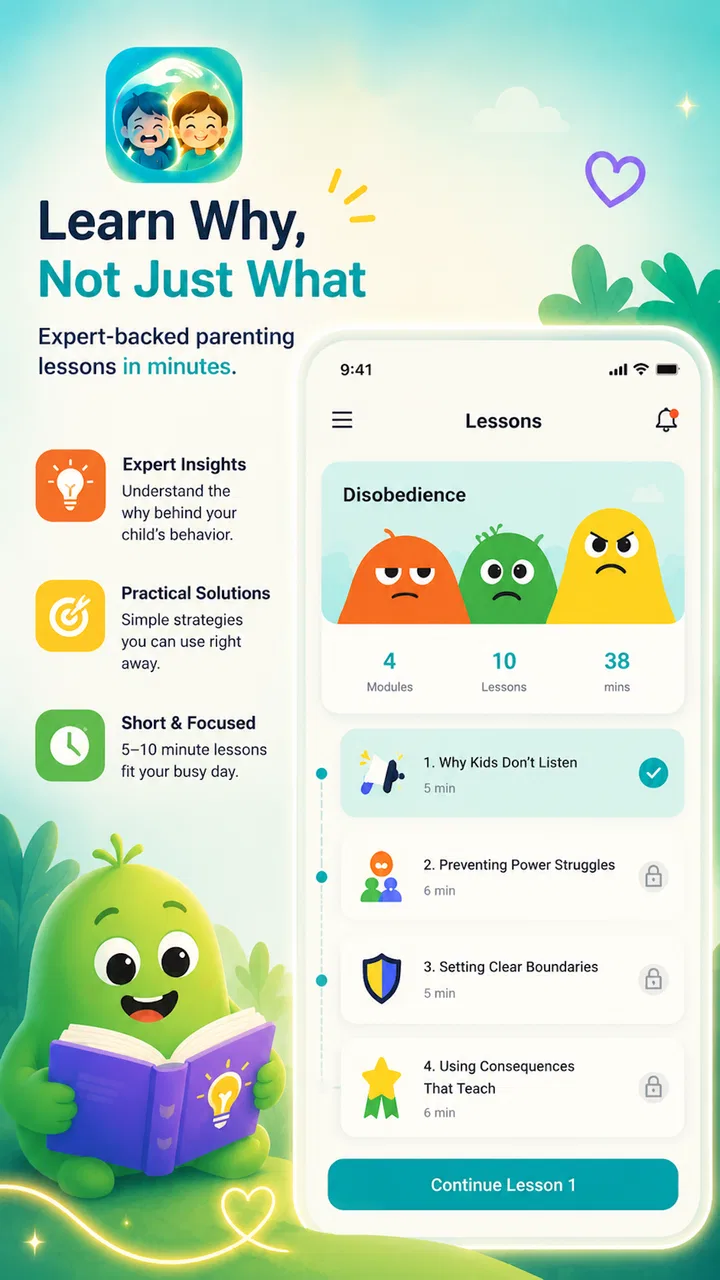
Parenting advice is easy to collect and surprisingly hard to use when a child is shouting, refusing a routine, or testing the same limit for the fifth time. Parenty - Child Behavior Guide takes a more practical route: it is a parenting app from Camille Labs built around learning, practicing, and reflecting on responses to child behavior. I found that focus more useful than another feed of broad parenting tips, because it asks me to think about what I will do in a specific moment rather than simply agree with a general principle.
The app is free to start, is rated for Everyone, and runs on Android devices using version 7.0 or later. It has reached over 10K installs and holds a 4.8 average from around 94 ratings, which suggests that its focused approach is connecting with a modest but interested audience. The current version is 1.0.61, and optional in-app purchases range from $3.49 to $49.99 per item. Those details matter because this is not a replacement for professional care or a complete family-management platform; it is a guided tool for improving how a parent interprets and handles everyday behavior.
Turning a difficult moment into a practice exercise
The most important capability here is the combination of behavior guidance and reflection. Instead of treating a child’s action as an isolated problem to suppress, Parenty encourages me to examine the situation, consider my response, and build a more deliberate habit. That shift sounds small, but it changes the question from “How do I make this stop?” to “What is happening, and what response is likely to help?”
You May Also Like

 Blood Strike: 2.5 Anniversary
Blood Strike’s Loadouts Turn Every Drop Into a Tactical Gamble
A close look at Blood Strike’s custom loadouts: how fast access to signature weapons reshapes its battle royale rhythm, rewards preparation, and narrows the gap between fights.

 Pandora - Music & Podcasts
Pandora’s Music Is Easy to Start, but Harder to Recover
Pandora’s strength is its low-effort path from a seed to a station. Its weak spot is how much confidence it asks you to place in connection, setup, and quiet recovery.

 8 Ball Pool
 Is Built on Rivalries, Rematches, and Routine
A close look at the rivalries, rematches, shared routines, and unanswered safety questions that turn a quick pool match into a persistent mobile community.

 Samsung Music
’s Quiet Strength Is Playing What You Already Own
Its reach comes less from spectacle than from dependable access to a personal library. That simplicity is both the app’s strongest retention engine and its ceiling.

 AccuWeather: Weather Radar
AccuWeather Review: A Quick, Clear Forecast for Everyday Decisions
For everyday plans, the best forecast is the one you can understand quickly. AccuWeather makes rain timing, radar, and local conditions easy to act on, with a few trade-offs.

 Hill Climb Racing
Why Hill Climb Racing Still Turns Crashes Into One More Run
A tiny car, a bumpy hill and one more upgrade: Hill Climb Racing keeps resurfacing because its simple chaos makes every near-miss feel personal.
More From Our News Desk
View All News


That distinction is especially valuable during repeated situations. A child who refuses to leave the playground, for example, may not need a completely new parenting philosophy. The parent may need a calmer sequence: prepare the child for the transition, state the limit clearly, acknowledge the frustration, and follow through without turning the departure into a negotiation that lasts forever. The app’s learning-and-practice orientation makes that kind of sequence easier to rehearse before the next difficult outing.
I like that the concept is not limited to discipline in the narrow sense. Behavior guidance can affect bedtime, meals, sibling conflict, screen transitions, public tantrums, and the ordinary resistance that appears whenever a child is tired or overwhelmed. A useful guide should help a parent notice patterns and choose a response that is firm without being unnecessarily harsh. That is the practical space where this app makes the most sense.
The real benefit is not having a perfect script; it is creating a pause between the child’s behavior and my automatic reaction. That pause can prevent a parent from escalating simply because the child has already escalated. It also makes reflection more concrete. Rather than vaguely deciding to “be more patient,” I can think about which part of the interaction broke down and what I might try differently next time.
Why practice matters more than another advice article
Traditional parenting articles are often useful when I have time to read them calmly. They explain ideas such as consistency, choices, boundaries, and emotional regulation. The problem is that reading does not guarantee recall when a child is crying beside the front door and everyone is late. Parenty’s emphasis on practice is better suited to that gap between understanding a principle and applying it under pressure.
My strongest impression is that the app works best when used before the hard moment, not only during it. A short session while the house is quiet can help me decide what a reasonable boundary looks like, what words I want to use, and where I am likely to give in. That preparation reduces the need to improvise while frustrated. It also makes the app feel more like a training aid than a digital encyclopedia.
Reflection has another advantage: it can reveal whether the adult’s goal was realistic. If I expect a tired preschooler to accept every transition cheerfully, I may interpret normal resistance as defiance. If I expect instant compliance from a child who is already overwhelmed, I may choose a response that adds pressure. Looking back at the situation helps separate the child’s need from my own urgency.
This does not mean every behavior has a hidden explanation or that boundaries should disappear. A child can be upset and still need to stop hitting, leave a dangerous area, or follow a household rule. The useful balance is recognizing emotion without treating emotion as permission for unsafe behavior. That balance is where a guided practice tool can be more helpful than slogans about either strictness or total accommodation.
Using it in an ordinary family routine
Consider a realistic evening. Dinner is ready, one child refuses to come to the table, and another is already complaining about the food. My first instinct might be to repeat the instruction louder, threaten a consequence, or abandon the meal entirely. A better use of Parenty would be to work through the situation earlier in the day: identify the specific limit, decide whether a small choice is appropriate, and plan how to respond if the refusal continues.
At dinner, that preparation might sound like, “You can sit here or there, but dinner is starting now.” If the child protests, I can acknowledge the disappointment without opening an endless debate. Afterward, reflection helps me ask whether the choice genuinely helped, whether I explained too much, and whether the consequence was connected to the behavior or merely a punishment chosen in frustration.
The non-obvious value is in separating the stages. Learning gives me a framework, practice turns it into a response I can remember, and reflection shows whether the response worked for this child and this context. Skipping the final stage is a common mistake. A technique that works during a calm morning may fail at the end of a long day, and that does not automatically mean the whole approach is wrong.
Where the app fits among familiar alternatives
Parenty occupies a middle ground between general parenting content and professional support. Search engines can provide a huge amount of advice, but they also make it difficult to judge what applies to a particular age, temperament, or family situation. Social media discussions may feel relatable, yet they often reward confident opinions rather than careful reflection. Books and courses can go deeper, but they require more time and commitment.
This app’s advantage is its narrower purpose. It is designed to help a parent work on responses to child behavior instead of presenting an endless stream of unrelated family content. That focus can make it easier to return to the same skill repeatedly. On the other hand, anyone wanting detailed clinical explanations, developmental assessment, or a conversation with a qualified professional will need something beyond a self-guided app.
I would also distinguish it from a routine tracker or family organizer. Those tools can tell me when bedtime happened or whether a chore was completed. Parenty is more concerned with the interaction around the behavior: what I noticed, how I responded, and what I could practice. A parent who mainly needs calendars, reminders, shared shopping lists, or reward charts may find a dedicated family-management app more useful.
How I would use Parenty without making parenting feel like homework
The app becomes less intimidating when I give each session a narrow purpose. Instead of trying to improve every part of family life, I would choose one recurring situation, such as leaving the house, stopping a game, or handling sibling arguments. That makes the learning easier to connect to real life and gives reflection a clear target.
A practical workflow is to use the guidance when calm, rehearse one response in plain language, and then revisit the situation after it occurs. The rehearsal should be short enough to remember. If my plan requires a long explanation in the middle of a tantrum, it is probably too complicated. One clear limit, one acknowledgment of the child’s feeling, and one predictable next step are easier to carry into a stressful moment.
Another useful habit is to distinguish the behavior I want to change from the relationship I want to protect. For example, I can hold a boundary around throwing toys while still speaking respectfully and helping the child calm down. This prevents reflection from becoming a scorecard in which the parent labels the child as good or bad. The question is whether the response taught, protected, or clarified something important.
I would avoid opening the app only after I have lost my temper. In that state, I am likely to search for a quick fix or judge the guidance unfairly because I want immediate compliance. Used as a preparation tool, it has a better chance of changing the next interaction. Used as an emergency button, its value depends on whether I can slow down enough to apply what I am learning.
The tradeoff between guidance and personal context
Any self-guided parenting app faces a context problem. The same refusal can mean tiredness, anxiety, sensory overload, a need for control, or simple boundary testing. A general framework can help me respond thoughtfully, but it cannot observe the child, the family dynamic, or the full history of the situation. I should therefore treat the app as a way to generate better questions, not as an authority that can diagnose the reason behind every action.
That limitation is important for families dealing with persistent aggression, serious developmental concerns, trauma, or behavior that creates immediate safety risks. In those cases, professional advice is more appropriate, and an app should not delay it. Parenty can still support reflection around ordinary interactions, but it should remain supplementary rather than becoming the only source of guidance.
There is also a potential friction point in the purchase model. The app itself is free, while optional items cost between $3.49 and $49.99 each. That wide range means I would pay attention to what is included before committing to anything. A parent who wants a completely free resource may prefer library books, public health materials, or free educational content. Someone who values a structured experience may consider an optional purchase worthwhile, but only if the extra material matches a specific need.
The app’s Everyone content rating makes it approachable for a broad audience, although the subject matter is aimed at adults caring for children. I would not interpret the age label as meaning that children are the intended users. The useful audience is parents and caregivers who want to improve their own responses, not children looking for entertainment.
Who is most likely to benefit
Parenty is a strong fit for a parent who notices the same conflict happening repeatedly and wants a method for changing the adult response as well as the child’s behavior. It should appeal to someone who prefers guided learning over scattered articles, and to caregivers who are willing to reflect honestly after an interaction rather than searching for a magic phrase.
It may be particularly useful during transitions: leaving activities, starting bedtime, turning off a device, getting dressed, or moving from play to school preparation. These moments are predictable, which makes them ideal for practice. The parent can anticipate the trigger, choose a consistent response, and evaluate whether the routine became calmer over time.
Co-parents could also use the same general approach independently and then compare what each person is trying to achieve. The important point is not to force identical personalities or wording. One parent may be more concise, while another is better at acknowledging feelings. Consistency is easier when the underlying boundary and follow-through are aligned, even if the exact sentences differ.
I would be more cautious recommending it to someone who wants instant solutions, extensive child-development reference material, or direct access to a specialist. It is also not the best match for a caregiver who dislikes self-reflection or who expects an app to make a child comply without changing the surrounding routine. The central work remains human: noticing, choosing, practicing, and adjusting.
What the audience numbers suggest, and what they do not
With over 10K installs and a 4.8 average from around 94 ratings, the response so far is encouraging, though the audience is still relatively small. I would read that as a reason to try the app with realistic expectations rather than as proof that every family will benefit equally. Ratings can show that many users like the concept, but they cannot replace a match between the app’s method and a family’s needs.
Camille Labs has released it as a focused parenting product rather than a broad collection of family utilities. The release date was October 28, 2025, and the current version is 1.0.61. For a relatively new app, I would keep an eye on how the guidance develops over time, especially if future updates make the practice and reflection process even easier to fit into busy routines.
My recommendation after using its approach
I recommend Parenty - Child Behavior Guide to parents who want to respond more deliberately when everyday behavior becomes difficult. Its best idea is simple but meaningful: learning about behavior is only the first step; parents also need a chance to rehearse a response and think about what happened afterward. That process can turn vague intentions such as “stay calm” into a repeatable plan for a particular family situation.
I would start with one recurring conflict, use the app before the next occurrence, and judge it by whether I feel better prepared rather than whether the child suddenly becomes cooperative. That is a fair test of its purpose. If the app helps me pause, set a clearer boundary, and reflect without blaming myself or my child, it is doing something useful.
It is not a substitute for medical, developmental, or psychological support, and it will not remove the need for patience, consistency, or conversation between caregivers. The optional purchases also mean that “free” does not necessarily describe every part of the experience. Still, for a parent looking for a focused guide instead of another generic advice feed, this is a thoughtful place to begin.
My final view is favorable because the app aims at the part of parenting that is easiest to overlook: the adult’s preparation and follow-up. When I use that capability intentionally, difficult moments become opportunities to practice a better response rather than proof that the whole routine is failing. That makes Parenty a worthwhile free starting point for caregivers who are ready to learn, try, and adjust.
FAQs for Parenty - Child Behavior Guide
01What is Parenty - Child Behavior Guide designed to help with?
Parenty - Child Behavior Guide is intended to help parents better understand children’s behavior and respond to common everyday challenges. It may provide practical guidance for situations such as tantrums, defiance, emotional outbursts, communication difficulties, routines, and discipline. The app is best viewed as an educational parenting aid rather than a replacement for personalized advice from a pediatrician, psychologist, or other qualified professional.
02Is Parenty suitable for every child and parenting situation?
The guidance in Parenty can be useful for many ordinary parenting situations, but it may not apply equally to every child, age group, family structure, or developmental stage. Children have individual needs, and behavior can be influenced by health, neurodevelopmental differences, trauma, environment, and other factors. Parents should adapt suggestions thoughtfully and seek professional support when behavior is persistent, severe, unsafe, or difficult to understand.
03Can Parenty replace a child psychologist, pediatrician, or parenting therapist?
No. Parenty should be considered a general information and self-help resource, not a diagnostic or medical service. It cannot assess a child personally, identify developmental or mental-health conditions, or provide emergency support. If a child may harm themselves or others, experiences serious distress, or shows sudden and concerning behavioral changes, contact an appropriate healthcare professional or local emergency service instead of relying only on app-based guidance.
04Does Parenty require an internet connection or personal information?
The exact requirements may depend on the current version of Parenty and the device platform. Some features or content may work offline, while updates, account functions, subscriptions, or synchronized data may require internet access. Before downloading, review the app-store listing and privacy policy to understand what information may be collected, how it is used, whether an account is needed, and whether third-party services are involved.
05Is Parenty free to download, and are there in-app purchases?
Parenty’s pricing and available features can change between Android and iOS versions, so parents should check the current store listing before installing it. The app may offer free content alongside premium tools, subscriptions, or in-app purchases. Pay attention to trial periods, renewal terms, and cancellation instructions, particularly if the app will be used on a family member’s device or through a shared store account.
Pros
- Offers practical guidance for handling common child behavior challenges.
- Helps parents respond more calmly and consistently in difficult moments.
- Advice is organized around everyday parenting situations.
- Can support better communication between parents and children.
- Useful as a quick reference when parents need immediate ideas.
Cons
- Some recommendations may feel too general for complex family situations.
- The guidance may not replace advice from a qualified child specialist.
- Parents may need to adapt suggestions to their child’s age and personality.
- Not every strategy will work equally well for different children.
- Some useful content may require time to read and apply consistently.

Parenty - Child Behavior Guide
Gallery